
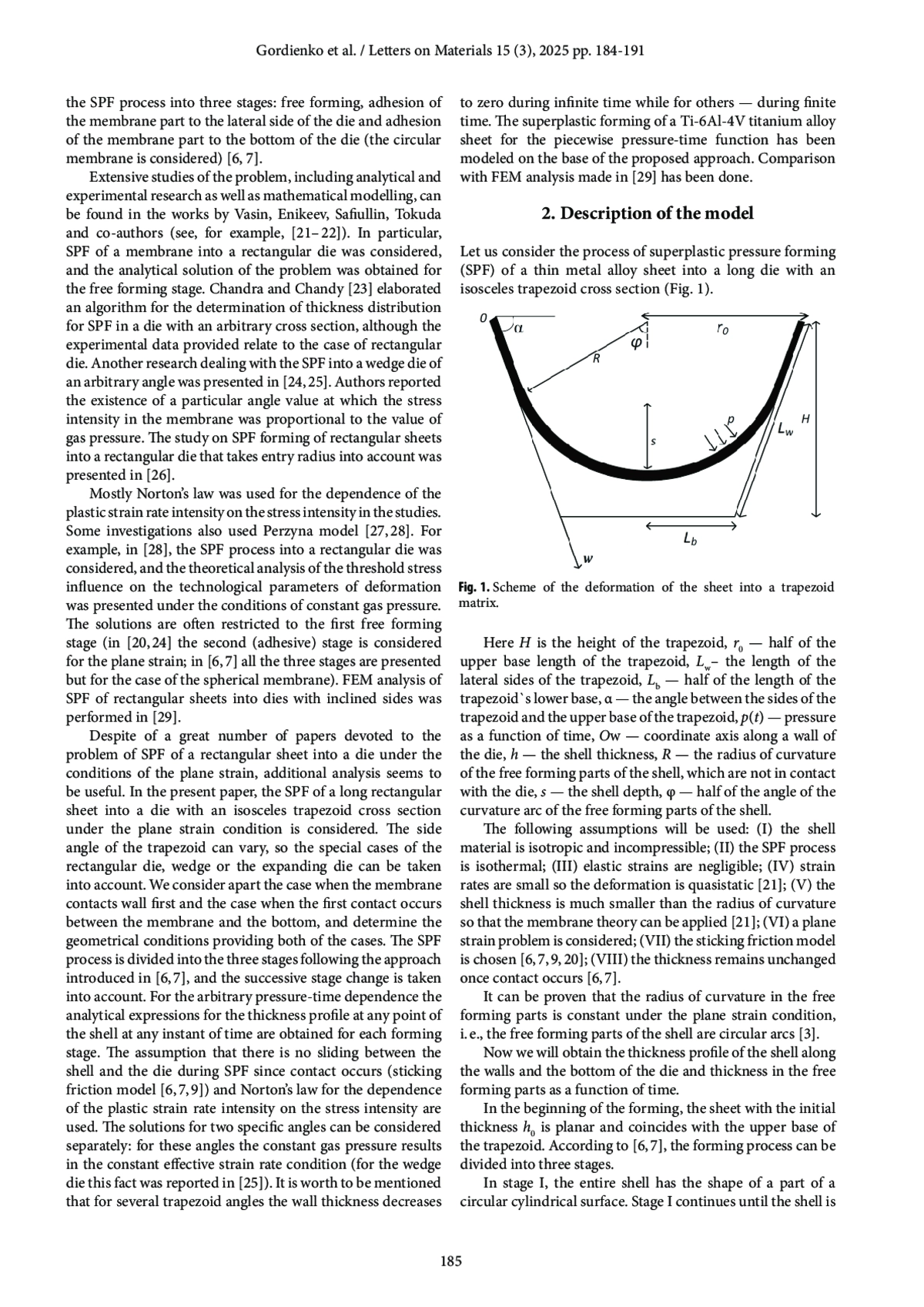
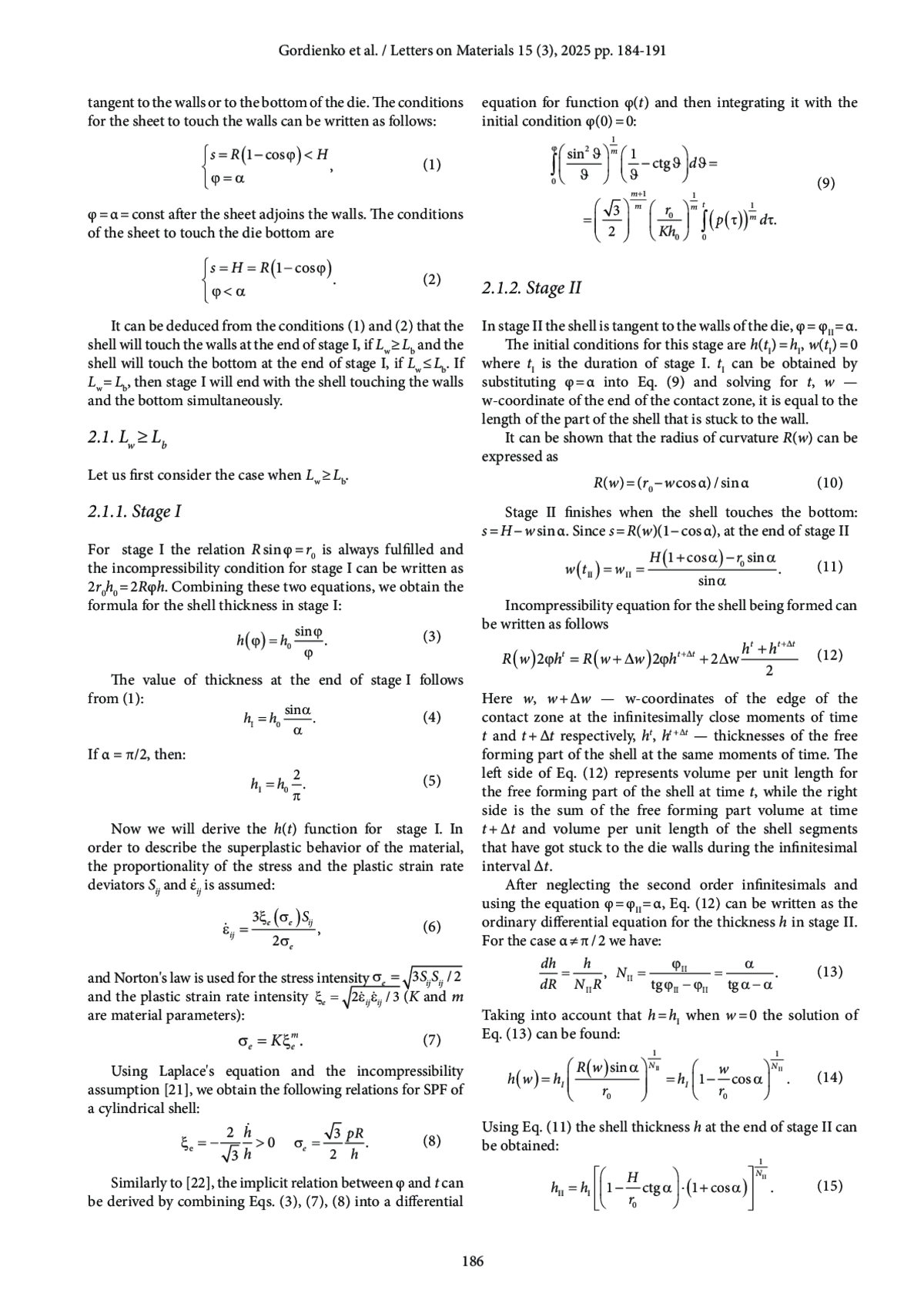
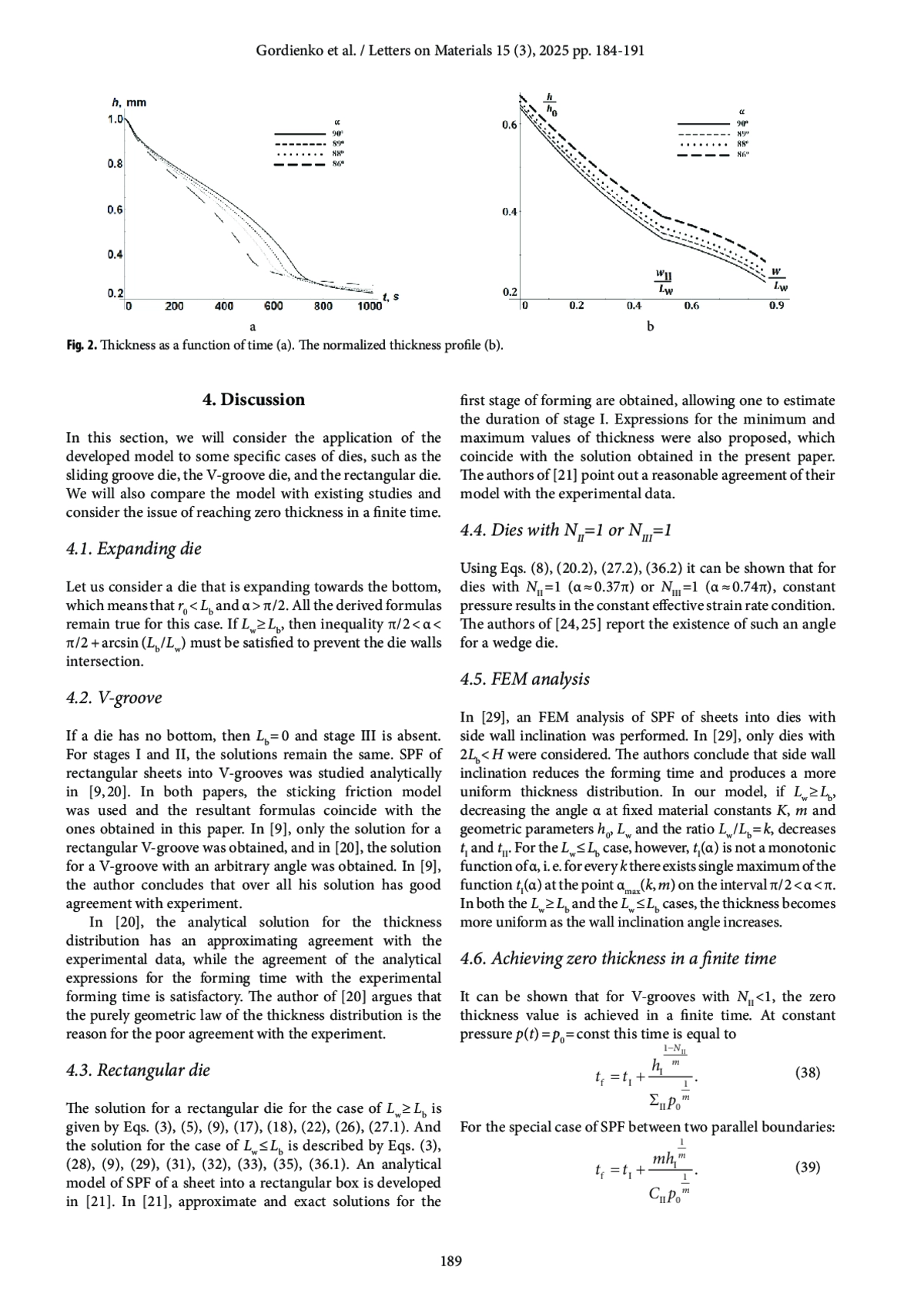
Superplastic deformation of thin sheets is widely used in aerospace, automotive and other industries. In this paper, a mathematical model of plane strain superplastic pressure forming of a sheet specimen into a die is proposed. A die under consideration has a shape of a long box with an isosceles trapezoid cross section, but the model can be generalized for more complex die shapes. It is assumed that sticking happens between a shell and a die and thickness remains unchanged once contact occurs. The process of forming was divided into different phases, which are determined by the die geometry. For each phase, ordinary differential equations for thickness were derived along with the initial conditions. Solutions of obtained ODEs allow estimating the shell thickness at any point of a specimen as a function of coordinate along walls of the die and to determine the duration of each superplastic pressure forming phase for a given pressure-time function. Norton’s power law was used as a constitutive equation. Due to the simplicity of Norton`s law it is possible to solve some of ODEs analytically. The proposed model can be used with other types of constitutive relations, in particular with relations that include microstructure parameters etc. The superplastic forming of a Ti-6Al-4V titanium alloy sheet for the piecewise pressure-time function has been modelled. Some special cases of die geometry are analyzed.
Предпросмотр статьи
Идентификаторы и классификаторы
- SCI
- Материаловедение
Among the practical applications of the phenomenon of superplasticity, the technique of superplastic forming (SPF) has acquired particular importance [1– 4]. Since the 1960s, superplastic forming of metal alloy sheets has become one of the main applications of superplasticity in various industries. The work by Jovane [5] appears to be the first research to analyze the bulging of a circular sheet clamped at its perimeter. The assumption of a uniform thickness for SPF of circular sheets, however, leads to a contradiction of the boundary conditions and hypothesis that the membrane holds the spherical shape at the deformation, as was observed by researchers (see, for example [1]). Furthermore, the thickness non-uniformity remains one of the important technical problems concerning SPF. A number of studies are devoted to solving the axisymmetric problem of the SPF of a round membrane (see, for example, [5 –19]). These SPF studies include analytical, experimental and FEM analyses.
Список литературы
1. K. A. Padmanabhan, R. A. Vasin, F. U. Enikeev, Superplastic Flow: Phenomenology and mechanics, Berlin-Heidelberg: Springer-Verlag, Berlin, 2001, 363 p. DOI: 10.1007/978-3-662-04367-7
2. Р. А. Васин, Ф. У. Еникеев, Введение в механику сверхпластичности. Т1, Гилем, Уфа, 2001, 280 с.
3. Н. Н. Малинин, Ползучесть в обработке металлов, Машиностроение, Москва, 1986, 222 с.
4. D. Sorgente, Superplasticity and Superplastic Forming, Metals 11 (2021) 946. DOI: 10.3390/met11060946
5. F. Jovane, An approximate analysis of the superplastic forming of a thin circular diaphragm: Theory and experiments, International Journal of Mechanical Sciences 10, 5 (1968) 403 - 427. DOI: 10.1016/0020-7403(68)90005-2
6. N. Chandra, D. Kannan, Superplastic sheet metal forming of a generalized cup. Part I: Uniform thinning, JMEP 1 (1992) 801- 810. DOI: 10.1007/BF02658264
7. N. Chandra, D. Kannan, Superplastic sheet metal forming of a generalized cup. Part II: Nonuniform thinning, JMEP 1 (1992) 813 - 822. DOI: 10.1007/BF02658265
8. А. А. Круглов, В. Р. Ганиева, О. П. Тулупова, Ф. У. Еникеев, Методы расчета продолжительности сверхпластической формовки круглой мембраны, Изв. ВУЗов, Цвет. Мет. 2 (2017) 66 - 75. DOI: 10.17073/0021-3438-2017-2-66-75
9. D. L. Holt, An analysis of the bulging of a superplastic sheet by lateral pressure, Int. Journal of Mech. Sci. 12, 6 (1970) 491- 497. DOI: 10.1016/0020-7403(70)90076-7
10. P. Guglielmi, D. Sorgente, A. Lombardi, G. Palumbo, A new experimental approach for modelling the constitutive behaviour of sheet metals at elevated temperature through interrupted bulge tests, Int. Journal of Mech. Sci. 184 (2020) 105839. DOI: 10.1016/j.ijmecsci.2020.105839
11. Т. А. Белякова, И. А. Гончаров, Влияние микроструктуры металлического сплава на распределение толщины в круглой пластине при сверхпластической формовке давлением, Вестн. СамУ, Естественнонаучн. сер. 26, 2 (2020) 50 - 62. DOI: 10.18287/2541-7525-2020-26-2-50-62
12. L. García-Barrachina, D. Sorgente, L. Tricarico, A. J. Gámez, A method for estimating superplastic material parameters via free-inflation tests, JMRT 11 (2021) 1387 -1395. DOI: 10.1016/j.jmrt.2021.01.116
13. R. V. Safiullin, V. A. Valitov, R. Y. Lutfullin, E. V. Galieva, E. Y. Klassman, Superplastic forming of EK61 nickel-based superalloy with ultrafine-grained structure, Lett. Mater. 12, 4s (2022) 439 - 444. DOI: 10.22226/2410-3535-2022-4-439-444
14. M. R. Shagiev, A. A. Kruglov, O. A. Rudenko, M. A. Murzinova, Superplastic forming of titanium alloys at 700°C, Lett. Mater. 12, 4 (2022) 332 - 335. DOI: 10.22226/2410-3535-2022-4-332-335
15. G. R. Murzina, V. R. Ganieva, A. A. Kruglov, F. U. Enikeev, Modeling of the process of superplastic forming of hemispherical shells from blanks of different profiles, Lett. Mater. 11, 4s (2021) 548 - 552. DOI: 10.22226/2410-3535-2021-4-548-552
16. Г. Р. Мурзина, В. Р. Ганиева, Ф. У. Еникеев, О. П. Тулупова, Программное средство для расчета технологических и геометрических характеристик процесса сверхпластической формовки, Int. Journal of Open Inf. Tech. 12, 11 (2024) 35 - 40.
17. I. Zakhariev, Numerical simulation of superplastic bulge forming test, J. Phys.: Conf. Ser. 1740 (2021) 012021. DOI: 10.1088/1742-6596/1740/1/012021
18. O. Tulupova, C. Gumerova, V. Ganieva, A. Kruglov, F. Enikeev, Improving the accuracy of finite element modeling of superplastic forming processes, Lett. Mater. 12, 2 (2022) 142 -147. DOI: 10.22226/2410-3535-2022-2-142-147
19. A. A. Kruglov, O. P. Tulupova, N. V. Olimpieva, V. R. Ganieva, F. U. Enikeev, Superplastic forming of hemispheres out of AZ61 magnesium alloy, IOP Conference Series: Mat. Sci. and Engineering, Ufa, 1008 (2020) 012050. DOI: 10.1088/1757-899X/1008/1/012050
20. A. R. Ragab, Thermoforming of superplastic sheet in shaped dies, Metals Technology 10, 1 (1983) 340 - 348. DOI: 10.1179/030716983803291262
21. R. A. Vasin, F. U. Enikeev, R. V. Safiullin, Mathematical Modeling of Superplastic Forming of a Long Rectangular Box Section, Mater. Sci. Forum 304 - 306 (1999) 765 - 770. DOI: 10.4028/www.scientific.net/MSF.304-306.765
22. R. A. Vasin, F. U. Enikeev, M. Tokuda, R. V. Safiullin, Mathematical modelling of the superplastic forming of a long rectangular sheet, Int. Journal of Non-Linear Mech. 38 (2003) 799 - 807. DOI: 10.1016/S0020-7462(01)00134-2
23. N. Chandra, K. Chandy, Superplastic process modeling of plane strain components with complex shapes, J. Mat. Shaping Technology 9 (1991) 27 - 37. DOI: 10.1007/BF02833630
24. L. Carrino, G. Giuliano, Analysis of Superplastic Testing by Using Constant Pressure in Prismatic Die, MSF 357 - 359 (2001) 219 - 224. DOI: 10.4028/www.scientific.net/MSF.357-359.219
25. A. Kh. Akhunova, S. V. Dmitriev, A. A. Kruglov, R. V. Safiullin, Superplastic forming of sheet into wedge die, Russian metallurgy (Metally) (2010) 9 38 - 41.
26. G. R. Murzina, A. R. Zharmukhametova, V. R. Ganieva, F. U. Enikeev, Method for calculating the parameters of superplasticity of titanium alloys based on the results of test forming into a rectangular matrix at constant pressure, Bulletin of the south Ural state university, 16, 1 (2023) 96 -107. DOI: 10.14529/mmp230108
27. А. Р. Горонкова, Ф. У. Еникеев, А. А. Круглов, Применение модели Пэжины для моделирования процесса сверхпластической формовки прямоугольной мембраны, Кузнечно-штамповочное производство, Обработка материалов давлением 9 (2016) 11-18.
28. А. А. Круглов, Ф. У. Еникеев, Конечноэлементное моделирование процесса сверхпластической формовки прямоугольной мембраны, Кузнечно-штамповочное производство, Обработка материалов давлением 2 (2019) 31- 40.
29. F. S. Jarrar, M. A. Nazzal, Inclination Angle Effect on the Thickness Distribution in a Superplastic Formed Long Rectangular Pan, MSF 735 (2012) 155 -161. DOI: 10.4028/www.scientific.net/MSF.735.155
30. R. Trân, F. Reuther, S. Winter, V. Psyk, Process Development for a Superplastic Hot Tube Gas Forming Process of Titanium (Ti-3Al-2.5V) Hollow Profiles, Metals 10 (2020) 1150. DOI: 10.3390/met10091150
31. M. N. Postnikova, A. D. Kotov, A. I. Bazlov, A. O. Mosleh, S. V. Medvedeva, A. V. Mikhaylovskaya, Effect of Boron on the Microstructure, Superplastic Behavior, and Mechanical Properties of Ti-4Al-3Mo-1V Alloy, Materials 16 (2023) 3714. DOI: 10.3390/ma16103714
32. A. D. Kotov, M. N. Postnikova, A. O. Mosleh, A. V. Mikhaylovskaya, Effect of Co addition on the microstructure evolution and superplastic behavior of Ti-4Al-3Mo-1V-0.1B alloy, Materials Research Proceedings 32 (2023) 181-188. DOI: 10.21741/9781644902615-20
33. N. Tian, X. Song, W. Ye, S. Hui, Superplastic Deformation Behavior of A β-rich α+β Titanium Alloy, JMRT 25 (2023) 1150 -1163. DOI: 10.1016/j.jmrt.2023.05.276
34. Y. Mi, Y. Lu, D. Wang, Y. Zhao, Y. Dong, H. Chang, I. V. Alexandrov, A Study of the Superplastic Deformation Behavior of Low-Cost Ti-2Fe-0.1B Alloys, Materials 17 (2024) 1282.
Выпуск
Другие статьи выпуска
The paper reveals the structure formation and magnetic properties of amorphous alloys based on the Fe-Co-Cr-B system with varying proportions of Fe to Co. These materials were obtained in the form of metal ribbons through the melt spinning technique in an inert atmosphere. In the initial as-spun state, the ribbons exhibited an amorphous structure characterized by their ferromagnetic properties. As the content of cobalt in the alloy composition decreased, the thermal stability of the amorphous phase matrix increased, leading to a shift in the crystallization mechanism from primary crystallization of the α solid solution phase to eutectic type crystallization of the initial amorphous phase. The phase composition of alloys during crystallization of the amorphous matrix phase is investigated. Alloys with a reduced cobalt content during the heating process undergo crystallization driven by the eutectic mechanism. This results in the formation of a mixture of α and Me3B phases. During this process, a significant increase in the magnetic moment of the alloys was detected. The α phase, which was formed by eutectic crystallization, was found to be enriched in chromium. It has been demonstrated that achieving a highly coercive state, it is contingent upon maintaining a Fe / Co ratio greater than 3, while simultaneously ensuring that the chromium content exceeds 16 at.%. The obtained data provides guidance for the development of functional materials with controlled magnetic properties.
This paper presents a modified small-angle X-ray scattering (SAXS) method for analyzing the size and shape of hardening particles in steels. Unlike the conventional SAXS approach, which typically analyzes alloy particles of only one morphology, the modified method enables simultaneous evaluation of various types of particles differing in both size and morphology. The essence of the modification to SAXS method is that it takes into account the contribution of the intensity of the separate types of particles with different morphologies to the total true intensity. For each type of particles, shape and structural coefficients are set taking into account their spatial distribution in the analyzed area. To detect the presence of particles of different morphologies in alloys, the experimental patterns are analyzed. First, based on the I(q−n) dependence, the morphology of the existing types of particles was traditionally identified (cylinder / needle (n =1), plate / disk (n = 2), and ellipsoid / sphere (n = 3, 4)). Subsequently, individual regions of the SAXS curve were analyzed in the context of optimizing the size and shape of various particles. The modified SAXS method was tested for analyzing the morphology and size of cementite particles in ferrite-pearlite steel subjected to annealing. As a result, it was shown that during the annealing process of steel, cementite particle morphology in pearlite grains undergoes a stepwise transformation according to the following scheme: lamellar → ellipsoidal → spherical. For the first time, quantitative characteristics of the change in particle size distribution were obtained for different morphologies. The transformation of cementite particle morphology was found to be accompanied by growth, which leads to a decrease in the contribution of dispersion hardening.
Silicene, as a silicon analogue of graphene, has attracted increasing attention due to its combination of physical and chemical properties, making it a relevant material for flexible electronics and nanotechnology. In this study, molecular dynamics simulations were used to study the effect of dislocation dipoles on the deformation behavior and mechanical properties of silicene under uniaxial tension. The wrinkle formation during tension was analyzed. Dislocation dipoles with different arm lengths were considered. A comparative analysis with graphene, the benchmark two-dimensional material, was also performed. The results showed that the strength of silicene smoothly decreases with increasing defect size. In contrast, graphene exhibits a sharp drop in strength when a critical defect size is reached; thereafter, further increases in the defect size have little effect on its mechanical properties. At the same time, the fracture strain of both materials depends only weakly on defects due to their ability to form wrinkles, which redistribute stress throughout the structure. The simulation results revealed differences in the wrinkle morphology of graphene and silicene, which are determined by their atomic structures. The planar structure of graphene forms uniform one-dimensional ripples, whereas the buckled structure of silicene leads to the formation of inhomogeneous wrinklons. Unlike graphene, with transition from a flat to a wrinkled state and from a wrinkled to a flat state again during deformation, the wrinkles in silicene persist until failure. These results are important for studying the strength and defect influence in two-dimensional materials, as well as for assessing their potential applications in flexible electronics.
A method of wire electron beam additive manufacturing of cylindrical bimetallic products made of CuAl9Mn2 aluminum bronze and 13Mn6 ferrite-perlitic steel was proposed for the first time to achieve strong defect-free joining of components. Cylindrical bimetallic tribotechnical components based on 13Mn6 steel and CuAl9Mn2 bronze showed a high degree of structural homogeneity and defect-free gradient zone structure when bronze was applied over steel. When the steel component is applied over bronze, the degree of mutual mixing of the components in the gradient zone increases sharply due to the high temperature of the steel relative to the bronze base. This leads to the formation of defects in the form of cracks and delaminations in the boundary zone. Despite the inhomogeneous structure of the transition zone of the samples where steel is applied over bronze, no embrittlement of the material due to infiltration of bronze into the imperfections of the steel fragment is observed, and the mechanical properties of the steel and the transition zone even exceed the similar parameters of the samples where bronze is applied over steel. The studies have shown that by the method of wire electron beam additive technology it is possible to form large-size structures from heterogeneous materials with strong and defect-free connection of components. The results obtained show that there are still tasks for further modification of the technology of wire electron beam printing of products of “bronze−steel” system with application of steel over bronze.
Using the molecular dynamics method, a study of the compression deformation of nickel nanoparticles with amorphous and nanocrystalline structures at low temperatures was conducted. The influence of the size of nanoparticles on their strength and on the strain value at which maximum stress is reached has been investigated. The characteristics of deformation behavior in the case of amorphous and nanocrystalline nanoparticles were identified. It was shown that as the size of the nanoparticles decreased, both for amorphous and nanocrystalline types, their strength increased. The strength values for nanocrystalline nickel particles were approximately twice as high as those for particles with an amorphous structure. With decreasing particle size, the strain value at which maximum stress was reached during compression of the nanoparticles also increased. One possible reason for the influence of particle size on its strength in the case of an amorphous structure may be densification and partial crystallization of the structure near the load application sites. Partial crystallization in the contact patch regions during compression of amorphous nanoparticles was observed in the model in most cases. During compression of particles with a nanocrystalline structure, frequent phenomena included grain rotation and grain boundary sliding. As with amorphous nanoparticles, the phenomenon of structural densification near the contact patches and its reorientation were observed, such that the most densely packed atomic planes of the (111) type became parallel to the contact patch plane.
In this paper, we study the effect of a hole-shaped structural defect on the size and density, as well as the thermal stability of skyrmions and the skyrmion lattice in a magnetic monolayer with a triangular lattice and a planar Dzyaloshinskii−Moriya interaction, using the local relaxation method and Monte Carlo simulations. Achieving control over the skyrmion density opens possibilities for the design of functional skyrmion-based devices. It is shown that increasing the Dzyaloshinskii−Moriya parameter increases the skyrmion density, while the presence of an external magnetic field promotes the degeneracy of the mixed configuration of skyrmion-domains into the skyrmion lattice. We demonstrate that the presence of a hole-shaped defect does not affect the phase diagram of the skyrmion gas and the skyrmion lattice, but acts as a stabilizing factor against thermal fluctuations. The thermal stability was studies using Monte Carlo simulations to calculate the order parameter and the order parameter susceptibility. It is shown that for certain combinations of the external magnetic field and the Dzyaloshinskii−Moriya parameter, there is an optimal size of the structural defect that allows achieving the maximum critical temperature of the phase transition The results obtained in this study can be useful for assessing the size of the defect and the values of interaction parameters in a magnetic material with high transition temperatures in the presence of a strong planar Dzyaloshinskii−Moriya interaction.
Titanium alloys are indispensable in the aerospace, nuclear and automotive industries due to their high specific strength, excellent creep resistance and corrosion resistance, but their use is seriously limited due to poor wear resistance. The method of еlectrospark deposition using a non-localized electrode consisting of a mixture of titanium granules with the addition of 6 –12 vol.% boron carbide powder was used to obtain metalloceramic coatings Ti-TiB2 / TiC onto Ti-6Al-4V titanium alloy. The results of the study show that the coatings contain αTi, TiB, TiB2 and TiC phases. It was found that with an increase in the content of boron carbide powder in the electrode to 12 vol.%, the total ceramics concentration increases to 93 vol.%. According to the metallographic analysis data, the coating thickness varied from 43.6 to 57.6 μm. The Vickers microhardness of the coatings increased monotonically from 8.13 to 12.02 GPa with increasing ceramic concentration. The use of the developed coatings allows increasing the wear resistance of the surface of the Ti-6Al-4V titanium alloy by 48 and 71 times at loads of 25 and 50 N, respectively. The technology is proposed for applying metal-ceramic coatings to the Ti-6Al-4V alloy using B4C powder, which surpasses the corresponding laser coatings in hardness and wear resistance due to a many times higher concentration of reinforcing phases: TiB2 and TiC.
Enhancing the strength, hardness, and wear resistance of aluminum alloys can be done through composite forming. According to the methods of production, composites can be classified into two types: ex situ and in situ composites. In ex situ composites, the reinforcing particles do not interact with the matrix, whereas in in situ composites, a chemical reaction occurs between the reinforcing particles and the matrix. Friction stir processing (FSP) is a promising approach to forming in situ composites, as it involves the frictional mixing of solid-state metal through the combined rotational and linear movement of the tool. The aim of this work was to study the impact of multi-pass FSP on the microstructure and microhardness of the in situ composite formed on the surface of an AA6063 alloy with pre-incorporated NiO particles. For this purpose, 4-, 10-, and 20‑pass FSP of AA6063 alloy sheets with grooves filled with fine NiO powder were performed. The chemical reaction between NiO and the aluminum matrix leading to the formation of Al3Ni and Al2O3 was studied using EDS, EBSD and X-ray diffraction techniques. It was found that the quantity of Al3Ni and Al2O3 particles increased with the number of FSP passes. The maximum surface microhardness of 253 HV is reached after 10 passes. As the number of FSP passes increases, the grain / subgrain sizes of the aluminum matrix decrease. After 10 passes, the grain / subgrain sizes stabilize at a level of 0.8 – 0.9 μm.
In this work, an ab initio study of a triangulated boron nanotube as an anode material for lithium-ion and sodium-ion batteries was performed for the first time. In the work, two boron nanotubes of “armchair” type (21, 0) and “zigzag” type (14, 0) were considered. The parameters such as Li / Na adsorption energy, electrical conductivity, specific capacitance, diffusion barriers and open-circuit voltage in a boron nanotube were calculated for varying Li / Na concentration upon three charge / discharge cycles. The study revealed that: a) Li / Na atoms are strongly bonded to the atomic structure of boron nanotube and their adsorption energy does not exceed the cohesive energy for bulk Li / Na; b) the energy barrier for Li / Na diffusion in the boron nanotube is 26.2 meV for Li and 17.0 meV for Na; c) the specific capacitance of a boron nanotube is 619.8 mAhg−1 at an average open circuit voltage of 0.70 V (relative to Li / Li+) and 0.66 V (relative to Na / Na+); d) calculation of electrical conductivity showed an increase in the resistance of the boron nanotube after three charge / discharge cycles up to 931 Ohm for Li and 632 Ohm for Na; e) after three charge / discharge cycles, the total energy of the boron nanotube reduced by 273 meV (Li) and 364 meV (Na) indicating an improvement in the equilibrium state after cycling. Analysis of the results confirms that triangulated boron nanotube is a very promising anode material for lithium-ion and sodium-ion batteries.
Издательство
- Издательство
- ИПСМ РАН
- Регион
- Россия, Уфа
- Почтовый адрес
- 450001, РБ, г. Уфа, ул. Степана Халтурина, 39
- Юр. адрес
- 450001, РБ, г. Уфа, ул. Степана Халтурина, 39
- ФИО
- Имаев Ренат Мазитович (Директор)
- E-mail адрес
- imsp@imsp.ru
- Контактный телефон
- +7 (347) 2236407